Back to projects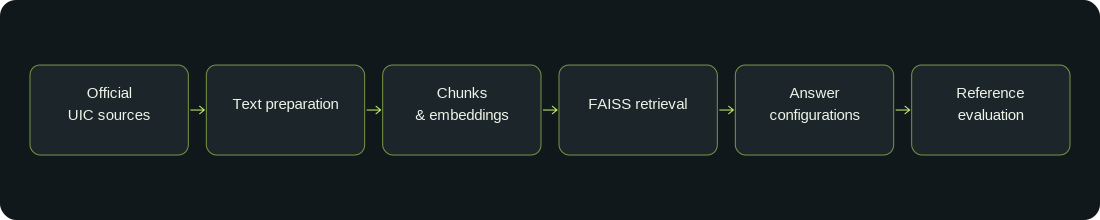
Generative AI · RAG · Evaluation
AdvisingBench
A benchmark for document-grounded academic advising answers.
What it solves
- AI assistants can generate convincing answers that misinterpret policies, omit conditions, or cite unrelated evidence. These errors matter when students rely on information for academic planning.
What I built / contributed
- Generative AI Development: Built an academic advising question-answering evaluation system using Python and Google Gemini API to assess how large language models answer university policy and academic advising questions.
- RAG Architecture: Implemented retrieval-augmented generation using Sentence Transformers and FAISS to embed university documents, perform semantic searches, and supply relevant context to LLM responses.
- LLM Evaluation: Designed a benchmark comparing LLM-only, basic RAG, and citation-grounded RAG across 30 evaluation questions, using 20 official UIC information sources and document chunks.
- Analytics & Visualization: Used Python, Pandas, and Streamlit to compare response quality, evaluate grounding and citation accuracy, and visualize differences between the three AI approaches.
Results & contributions
- 30 academic-advising questions in the local benchmark CSV.
- 20 university source entries in the local source catalog.
Technologies
- Languages & processing: Python · Pandas
- Retrieval: Sentence Transformers · FAISS · Semantic search
- Application & evaluation: Streamlit · Reference answers · Citation evaluation
How it works & architecture
- Official UIC sources
- Text preparation
- Chunks & embeddings
- FAISS retrieval
- Answer configurations
- Reference evaluation
Engineering decisions & evidence
- Use official public university sources to make policy evidence traceable.
- Evaluate answer correctness and citation grounding separately; retrieving a document does not itself establish a correct answer.
- Keep source metadata and code accessible while avoiding publication of private student information.
- Benchmark and source counts were checked against the local CSV files. The repository includes retrieval code, answering configurations, evaluation templates, and a technical report. Numerical answer-accuracy scores are not included here.