Back to projects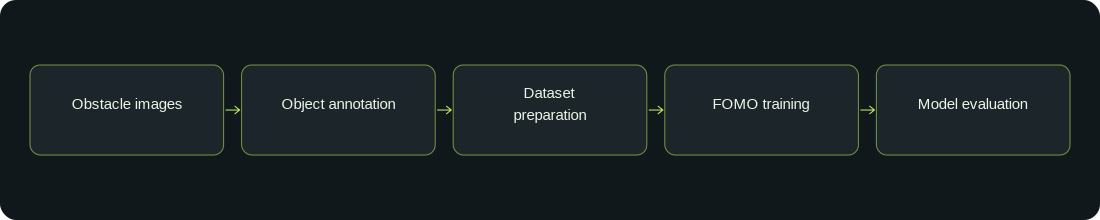
Computer Vision · TinyML · Robotics
Edge AI Obstacle Detection
Lightweight computer vision for resource-constrained robotics.
What it solves
- Robotics platforms need to recognize surrounding obstacles while operating within limited memory and computing resources. Large vision models can be unsuitable for these constraints.
What I built / contributed
- Custom labels for people, poles, signs, trees, cones, and structural obstacles.
- Image preparation and annotation for object detection.
- Lightweight model training and evaluation workflows.
Results & contributions
- Built and labeled 1,700+ images, as documented in the supplied research résumé.
- Trained and evaluated FOMO models for an obstacle-detection research task.
Technologies
- AI & models: Computer vision · TinyML · FOMO · Object detection
- Platform & practices: Edge Impulse · Image annotation · Model training · Model evaluation
How it works & architecture
- Obstacle images
- Object annotation
- Dataset preparation
- FOMO training
- Model evaluation
Engineering decisions & evidence
- Choose a lightweight detection architecture suited to resource-constrained robotics.
- Treat dataset labeling as a core engineering task because class definitions and annotation consistency shape model evaluation.
- Keep model-development results distinct from claims about deployed robot behavior.
- This case study is based on the supplied research role description for October–November 2025. The workflow diagram summarizes that description. No accuracy, latency, or hardware-deployment figures are asserted.