Back to projects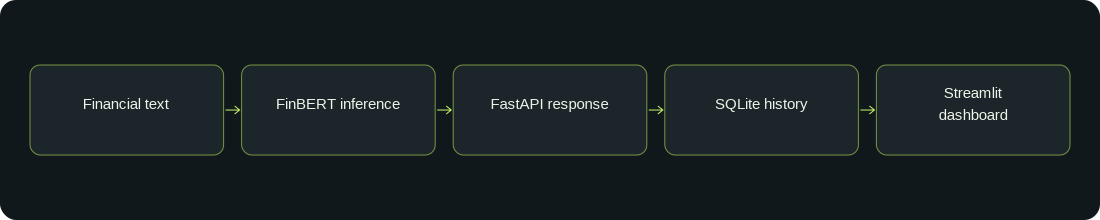
Natural Language Processing · Financial AI
Financial Market Sentiment Intelligence
Financial-language analysis with FinBERT, APIs, and an interactive dashboard.
What it solves
- Analysts must review large amounts of financial news. Manual categorization takes time, and generic sentiment models may miss financial terminology and context.
What I built / contributed
- Financial NLP: Developed a financial news sentiment analysis application using Python, Hugging Face Transformers, and FinBERT to classify headlines and articles as positive, negative, or neutral.
- Machine Learning Inference: Implemented FinBERT-based inference to generate sentiment predictions and confidence scores, transforming unstructured financial news into structured analytical data.
- Backend & Database: Built FastAPI REST endpoints to serve sentiment predictions and used SQLite to store financial news, classification results, and historical analysis records.
- Analytics & Visualization: Developed an interactive Streamlit dashboard to visualize sentiment distributions, examine news trends, and support financial market research.
Results & contributions
- Integrated pretrained financial-language inference with backend services.
- Connected sentiment records to persistent storage and a dashboard.
Technologies
- Languages: Python · SQL
- AI & frameworks: FinBERT · Hugging Face Transformers
- Backend & data: FastAPI · REST APIs · SQLAlchemy · SQLite
- Frontend: Streamlit
How it works & architecture
- Financial text
- FinBERT inference
- FastAPI response
- SQLite history
- Streamlit dashboard
Engineering decisions & evidence
- Use a financial-domain pretrained model for inference rather than claiming to train a transformer from scratch.
- Separate classification, API handling, storage, and presentation so each responsibility is explicit.
- Present sentiment as a text-analysis output; classification alone does not establish stock-price prediction or investment returns.
- The local implementation includes a Transformers sentiment pipeline using ProsusAI/finbert, FastAPI routes, SQLAlchemy-backed SQLite models, and a Streamlit application. The diagram below summarizes those components; it is not a captured execution trace.